A vision before its time?
We have already touched on Colonel D.K.B. Sellers and his affiliation with the University Heights Improvement Company. He, along with many others, will be re-occurring characters in the story of Nob Hill. University Heights, however, got its start before D.K.B. Sellers arrived in New Mexico.
Under the 1820’s Public Lands Act, there were two primary ways to obtain federal land in New Mexico. One being to purchase the land from the Federal Government, and the second to homestead. In 1898, George Albright (half-brother of well-known New Mexico newspaper man, J.G. Albright) purchased the 160 acres south of the University for $200. This was a solid gamble, as that happened to be the same year as the founding of the University of New Mexico, and he just happened to have served on the Albuquerque School Board from 1893-1894. Such land would become University Heights, bounded by Girard on the west, Carlisle Boulevard on the east, Central Avenue on the north and slightly past Garfield Avenue on the south. Albright received the Certificate, signed by President Harrison, in 1891. His later positions as Territorial Councilor in 1902, Bernalillo County Assessor in 1903 (See George F. Albright v. Territory of New Mexico if you want to get into the weeds on the allegation of Jesus M. Sandoval that Albright usurped his duly elected position to that office), as well as various other official positions may have both helped and harmed his future endeavors.
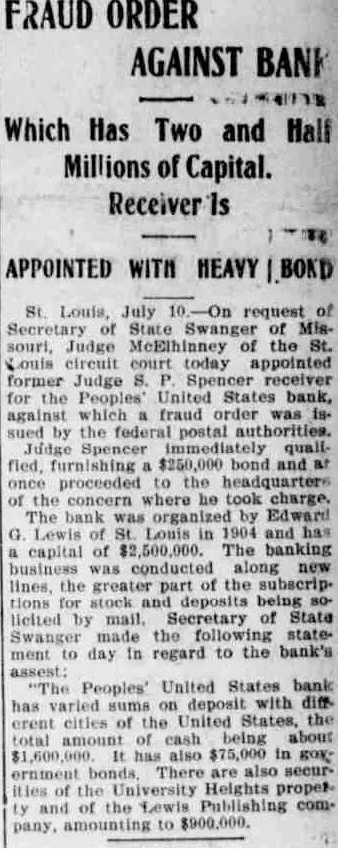
Albuquerque Evening Citizen, July 10, 1905
The development of University Heights got off to a bit of a rocky start. In 1905, the securities of the University Heights property became enmeshed in a banking scandal in St. Louis. And, in 1908, a bit of drama ensued involving Albright’s actions during his time as County Assessor with the treasurer of the First National Bank in Albuquerque and the County District Attorney regarding the valuation of stock and real estate (see First National Bank of Albuquerque, Appt., v. George F. Albright, Frank A. Hubbell, and F. W. Clancy for more details). All must have worked itself out in one way or another, since, in 1906, Albright platted the west section of University Heights (Yale Boulevard to Girard Boulevard), and, by 1915, University Heights Development Company had incorporated with offices in the First National Bank Building.
(enter DKB Sellers)
Albuquerque Evening Citizen, April 9,
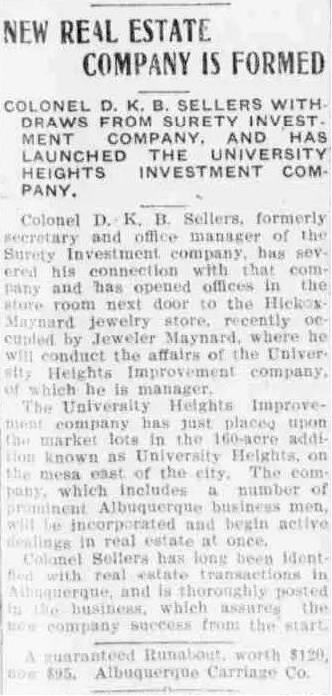
Around this period, DKB Sellers was keeping himself busy as president of the 1903 Territorial Fair, working with the Broadway Land and Improvement Company and the Surety Investment Company, dabbling in the Albuquerque Traction Company and other political endeavors, including boosting New Mexico Statehood.
In early April of 1906, Sellers announced his affiliation with the University Heights Improvement Company, serving as secretary with H.B. Fergusson as President and M.W. Flournoy as Vice-President. By May, he had started aggressively championing the extension of the streetcar and city waterlines to the East Mesa. In the early 20th century, streetcar franchises were a popular strategy used by land and improvement companies to draw buyers to land further away from city centers. In this case, Sellers’ interest in extending the streetcar probably was also necessitated by the difficulty traversing the sand dunes up the mesa.
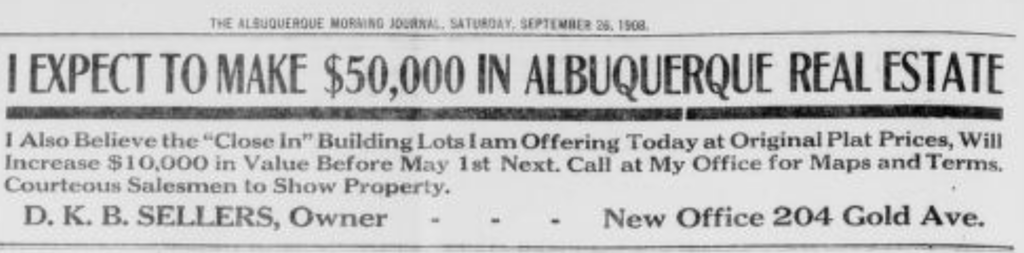
Advertisement, Albuquerque Morning Journal September 26, 1908.
According to a May 17, 1906, article in the Albuquerque Evening Citizen, Sellers had raised the needed funds to extend the water lines east from the city reservoir located at Yale Boulevard. By 1908, after Sellers spent a few years negotiating a rail franchise and trying to convince the Albuquerque Traction Company to expand their service to the east mesa, he succeeded in securing funds to create a new streetcar company with the Highland Line to UNM. He had also started to champion paving what is now Central Avenue from downtown to the university.
The First House
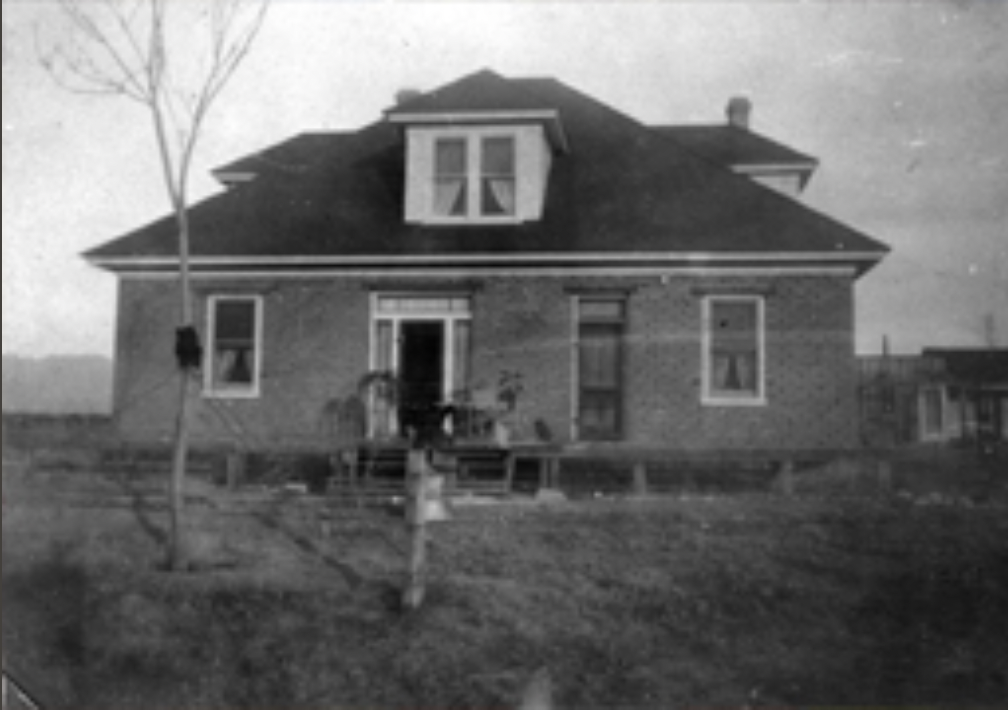
The first house in University Heights (west of Girard), known as the Werner Glichrist House, was built in 1908 at 202 Cornell SE. This home was built on half a block of land by Laura Werner, her son-in-law Ralph Gilchrist and daughter Nora Werner. Laura had served as D.K.B. Seller’s secretary. The land may have been given to her in lieu of salary or perhaps Seller’s though it was time someone actually started building in University Heights. Continuously occupied by the family until 1981 and placed on the historic register in 1982, it was torn down in 2011. According to the NPS Nomination form for the Werner-Gilchrist House, other Heights neophytes included L. Bradford Prince (Territorial Governor from 1889-1893) and University President William George Tight. Numerous faculty members, fraternities and sororities were also among the first to own lots near the university.
Despite the whirl of Seller’s activities, development in University Heights got off to a slow start (this should not have been unexpected as Martin Stamm’s Terrace Addition platted in 1902, just to the east, did not seem to be attracting residents and purportedly took an hour and a half to reach by horse and buggy from downtown). Not easily dismayed, the Colonel left no angle unexplored in his real estate marketing. In a 1906 advertisement, he offered University Heights as the “coming Aristocratic Center of Albuquerque.” In a 1908 advertisement for the University Heights Investment Company, posted in the Albuquerque Evening Citizen, now indicating Sellers as “owner,” he offered bargain prices for bachelors, publishing the names of well-known and popular young men as likely never having a chance to get married, offering them the joking chance to “go housekeeping single handed.” In doing so, outing a least one secret marriage and angering a few others.
Nonetheless, there were only eight houses in the western addition of University Heights by 1910.
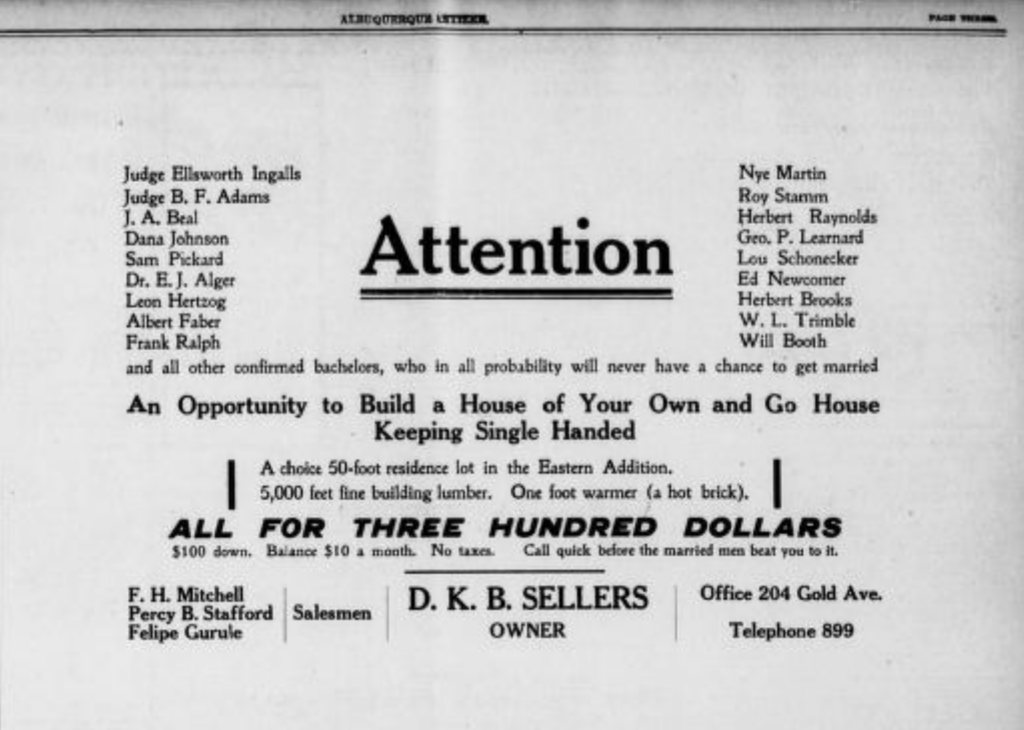
Albuquerque Citizen, December 17, 1908, Library of Congress, Image provided by UNM.
©️ 2026 Michelle Allison