TB tourism? Maybe not the best economic development strategy if you are trying to grow a city…
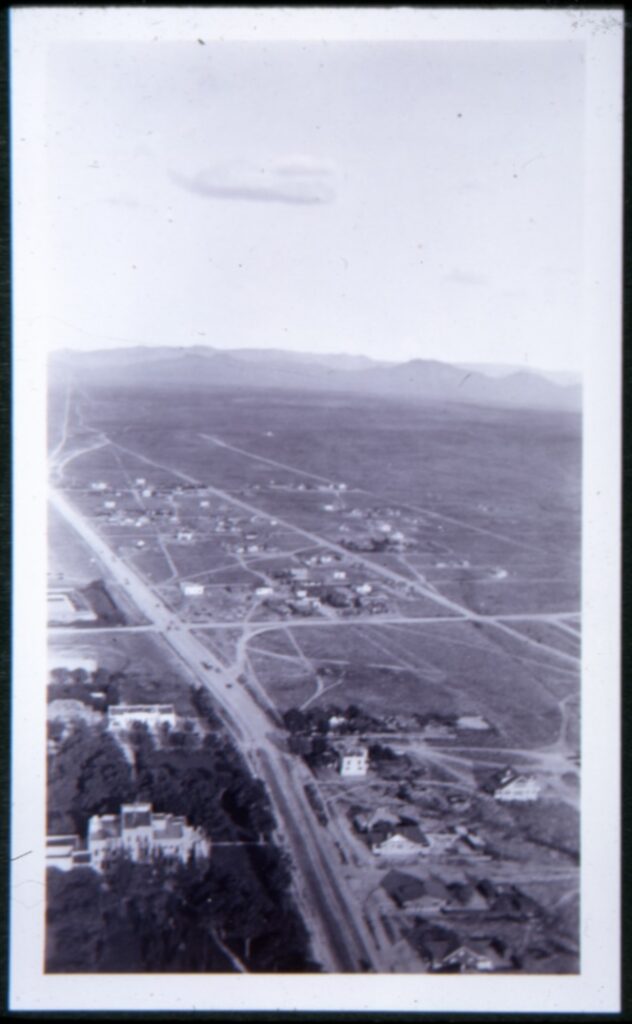
gelatin silver print, Albuquerque Museum, gift of
Benjamin B. Camp PA1982.161.001
Before we get too far into our story, let’s develop some more context. In 1920, the decade that marks the origin of Nob Hill and most of its surrounding neighborhoods, New Mexico had been a state for a mere 8 years, and 15,157 people lived within the Albuquerque city limits (which did not include Old Town, and the eastern edge of the city stopped approximately a block west of modern Yale Boulevard) with a population growth rate starting to sharply decline.
Early Economic Strategies
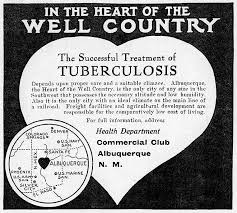
The early years of Albuquerque saw two fledgling industries, the railroad and “wellness.” In the 1890’s, the Albuquerque Commercial Club (precursor to the Albuquerque Chamber of Commerce) saw opportunity in the young town’s location on the Atchison, Topeka and Santa Fe Railway and began promoting the city to eastern residents of the US as the “Heart of Wellness Country,” seeking to attract people “chasing the cure.” This term at the time referred to those suffering from tuberculosis, known then as consumption. Their growth strategy seemed to work. A 1918 public health survey estimated that around 50% of Albuquerque’s population either had consumption or were family members of consumptives with 90% not being native to Albuquerque.
Unfortunately, it was not well understood that the disease was highly contagious. By 1909, tuberculosis had become the leading cause of death in the United States. The death rate from TB in Albuquerque was 7 times the national average – which might explain why the city’s population growth rate started to significantly decline in the 1920’s…
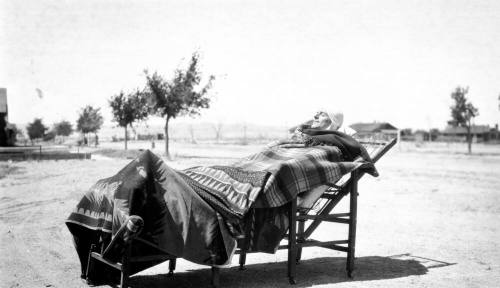
Seeking the “cure”
No cure existed for tuberculosis until the 1940’s, and, even then, treatment had limited effectiveness as the bacteria often became resistant. In the late 19th century, sanatoriums (institutions that provided good food, fresh air, and sunlight treatments also known as Heliotherapy), had moderate success treating the disease. By 1902, Doctors had started to open sanatoriums in New Mexico. To attract patients, many doctors performed “scientific studies” to prove that a high altitude, combined with a warm, dry climate had a higher success rate for curing tuberculosis than the damp eastern climate. The railroads also saw an opportunity to increase ridership, running ads touting the health benefits of the Southwest. By 1920, Albuquerque boasted 17 sanatoria, the majority of which could be found on Central Avenue between Broadway Boulevard and the University of New Mexico, earning it the name “San Alley” or “TB Avenue.”
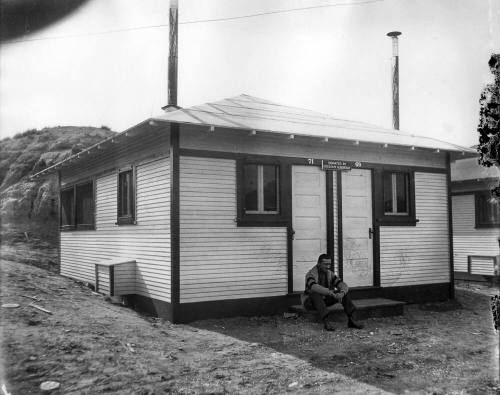
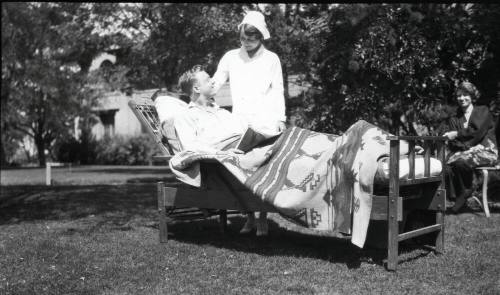
Albuquerque Museum, gift of John Airy PA1982.18426
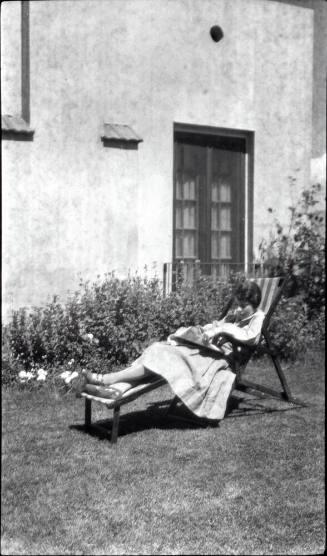
Albuquerque Museum, gift of John Airy PA1982.181.
While many chose to convalesce in a sanatorium, others could not afford to stay in the health resorts. Some slept in tents or lived in boarding and rooming houses, others selected to live with their families in small bungalows. With the growing number of health seekers arriving daily by train and the high infection rate of the local population, by the 1910’s Phthisiophobia (fear of TB) was on the rise. Soon boarding and rooming houses no longer accepted the sick and land deeds limited the number of infected people allowed to reside together in houses.
The Legacy of TB Today
So, what does TB have to do with the story of Nob Hill? Many of Nob Hill’s founding and notable residents came to Albuquerque seeking a cure. These new arrivals responded well to the aggressive real estate advertisements offering affordable lots above the “smoke and pollution” of the city with promises of clean air, beautiful views, and bountiful gardens.
Evidence of the “TB housing market” can be found today in many homes in the University Heights, Monte Vista, and College View neighborhoods. Many homes built prior to WWII reflect the “architecture of heliotherapy,” incorporating porches, sunrooms, and large windows to allow “lungers” – those inflicted with TB – to convalesce at home. Interesting to note, front porches are most prevalent in homes built prior to WWII, often disappearing in homes constructed post World War II. Perhaps these architectural changes coincided with the advent of antibiotics, lessening the demand for heliotherapy. Or, perhaps, people started to opt for homes without porches to distinguish themselves from those suffering with disease.
Most importantly, at least to our story, is that a few folks (who we will meet later in our story) took a pretty expensive bet on Albuquerque’s health seeking potential.
So did that gamble on the East Mesa payoff? Well, not as quickly as you might think…
©️ 2026 Michelle Allison