Nob Hill’s Checkered Past
Albuquerque’s East Mesa has long been synonymous with speed. The open desert, just outside the city limits, provided the ideal landscape for dirt track racing, drag strips, circuit tracks and road races, keeping dust and noise away from neighborhoods. Many racing fans will remember the 1960’s tracks along east Central such as the Navajo Speedway near the fairgrounds and the Sandia Speedway near Wyoming. A few die-hard race fans might know of Cormit Speedway (closed in 1954), or the notorious, but short-lived Hell’s Half Acre (1939), or possibly the Rio Grande Sports Bowl (closed in 1950). And of course, the Unser family fame secured Albuquerque’s racing legacy.
Yet Albuquerque’s racing history dates back a couple more decades…
In the Driver’s Seat
Automobiles first began to appear in New Mexico around 1900. The first vehicle owned in Albuquerque was a Locomobile, purchased in Denver, Colorado, in 1897 by R. L. Dobson, a local bicycle dealer. Many Albuquerque residents were unimpressed by the noisy machine, which frightened horses and disrupted the quiet streets. The reaction was so negative that town officials considered banning automobiles altogether, and Dobson reportedly received death threats.
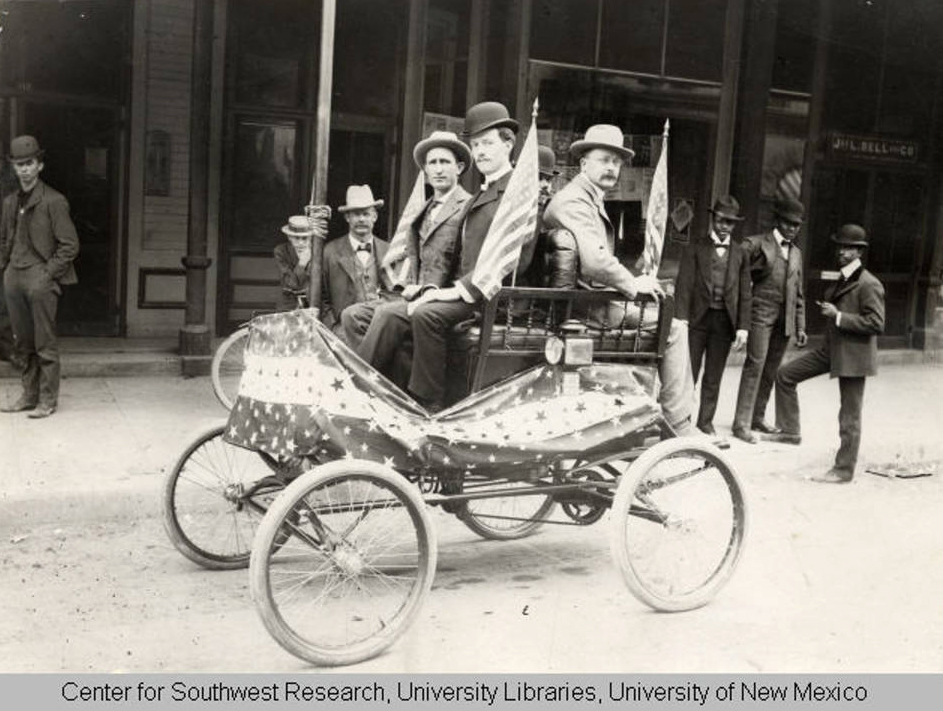
Dobson and his Locomobile.
Hitting the Road
The automobile, however, soon became a more common sight, and racing soon followed. A local paper indicates that New Mexico’s first auto race, involving four participants, took place on October 16, 1903. Only three cars finished the race. In 1908, Louis Galles opened the first car dealership in town, Galles Motor Company.
In 1912, 911 automobiles were registered in New Mexico and by 1913, Albuquerque was home to approximately 250 automobiles—enough for nearly 20 percent of households to own a car. That same year, notorious Nob Hill booster Colonel D. K. B. Sellers, an early automobile enthusiast and avid racing fan, organized the first AAA-sanctioned road race between Albuquerque and Santa Fe. By 1916, road races between Albuquerque and Santa Fe, as well as between Albuquerque and Gallup, had become common events. Local businesses often contributed prize money, hoping that the races promoted their communities and attracted visitors.
Sellers purchased his own racing automobile, the “White Wing,” in 1917. Apparently, the big racing automobile had too much power for the 1/2-mile track intended for horse racing at Traction Park (now Albuquerque’s Botanical Gardens) and did not take place in the racing events at the State Fair that year but made an appearance on exhibition.
Running on Empty?
In March 1917, Harry Leonard, owner of the famed downtown Capital Bar and a chief supporter of the Albuquerque Racing Association, announced the formation of the Albuquerque Speedway Association and the development of an A.A.A. sanctioned racing program in Albuquerque. The Association had acquired 160 acres of land outside of the city limits on the East Mesa for the purpose of building a 1 -mile oval track with a grandstand. Located about a mile east of the University, advertisements promised automobile transportation from the trolley line termination at Yale to the track. Upon inspection, Sellers declared the track the fastest in the southwest.
Despite much effort to construct the tract and establish a racing program, it is unclear if the speedway actually opened. In May of 1917, the local paper announced that the gravel and adobe track would not be ready for the scheduled opening on Memorial Day. By June, the paper stated that the grading was almost complete, and that the association had purchased a grandstand and would be ready to host the first race on July 4th. However, on June 30th, Harry Leonard called off the race program returning entry fees to drivers and postponing the first race to Labor Day. The local papers do not mention a Labor Day race taking place and the 1918 July 4th race took place at Traction Park near old town.
Those who know their history will recognize 1917 as an ill-fated year. On April 6th, the US became involved in the first world war and by early June a New Mexico National Guard mobilization unit had been established on the East Mesa. The construction of the track had taken longer than anticipated due to sandy soils and faced weather challenges and perhaps the pending deployment of the NM Troops or the war rationing prevented the opening of the track.
And if a world war was not enough bad luck in 1917 for Harry Leonard, in October his wife, died 10 days after an appendicitis attack and in November the state voted for prohibition, forcing an end to his livelihood.
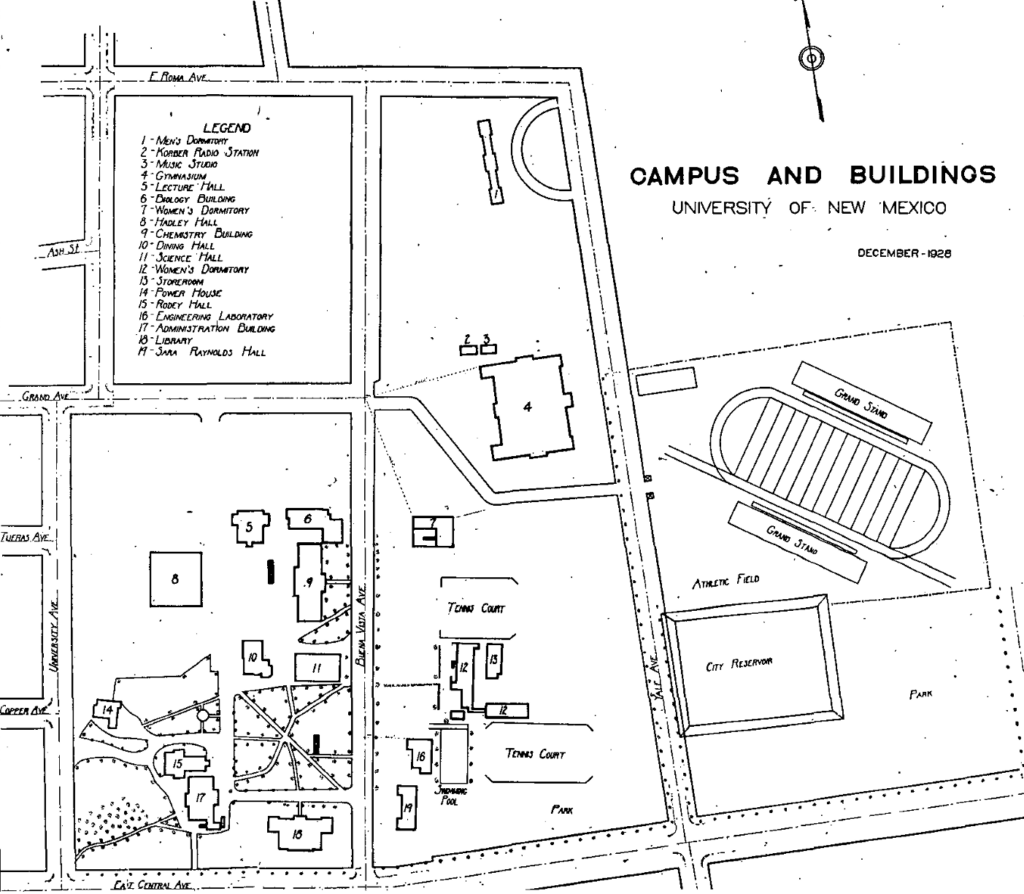
The location of this track is not entirely clear. Aerial photographs from around this time indicate that the track may have been on what is today the University campus. The dirt oval may have evolved into a university athletic field. The dirt oval is not visible on aerial photographs by 1935. Another possibility is that the track may have been located at the northwest corner of what is now Gibson Boulevard and San Mateo Boulevard. A 1915 land ownership maps identify this parcel as “Driving Park,” however this location would have been more than 3 miles from the end of the trolley line.
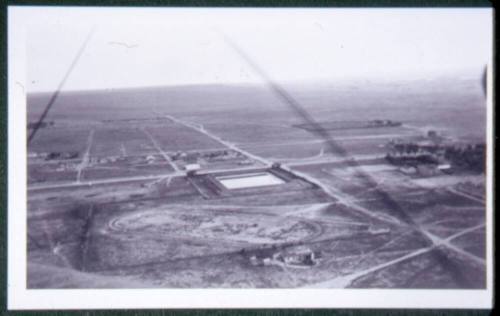
Dirt track located on what is now UNM’s campus, just east of Yale Boulevard. Image Credit: Albuquerque Museum, gift of Benjamin B. Camp, PA1982.161.007, ca. 1920.
Petal to the Metal
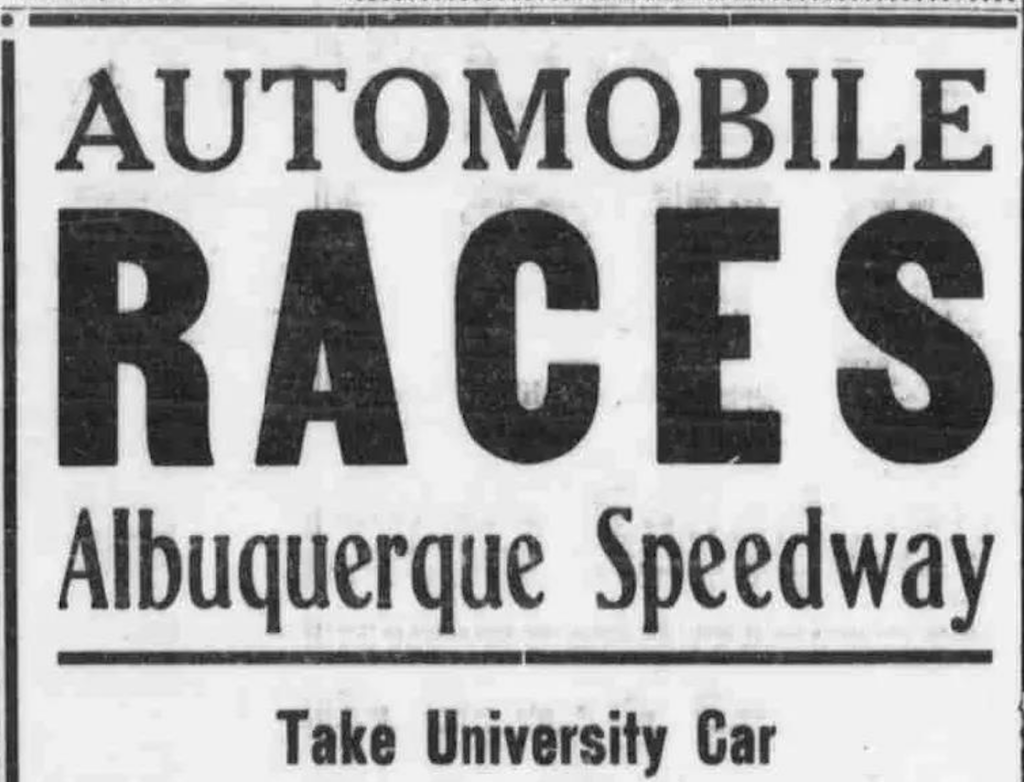
After the war, the Albuquerque Automobile Trades Association formed and opened a new 1-mile track east of the University, located south of Lomas Boulevard and east of Washington Boulevard in what is now the Heights Reservoir Addition. The track, sometimes advertised as “Mesa Racetrack” or “Albuquerque Speedway,” opened on Memorial Day 1919, featuring four events including a 10-mile motorcycle race, a 10-mile Ford race, a 10-mile free for all, and a 20-mile sweepstakes race. Clyde Tingley served as race manager and timer and D.K.B. Sellers as one of the judges. This track supported a regular racing program for several years.
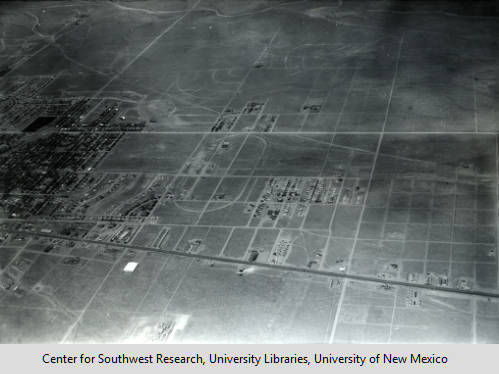
During his years as city commissioner, Clyde Tingley continued to serve as race manager and billed the speedway the “fastest mile track in the west.” D.K.B. Sellers, a regular race organizer, promoted a July 4th 50-mile race with a $1500 purse which is referenced as following A.A.A. regulations. In June of 1920, a two-day race was held June 12 and 13th. The track, known as the Mesa Racetrack, hosted a variety of racing events including a 1923 motorcycle race against an airplane.
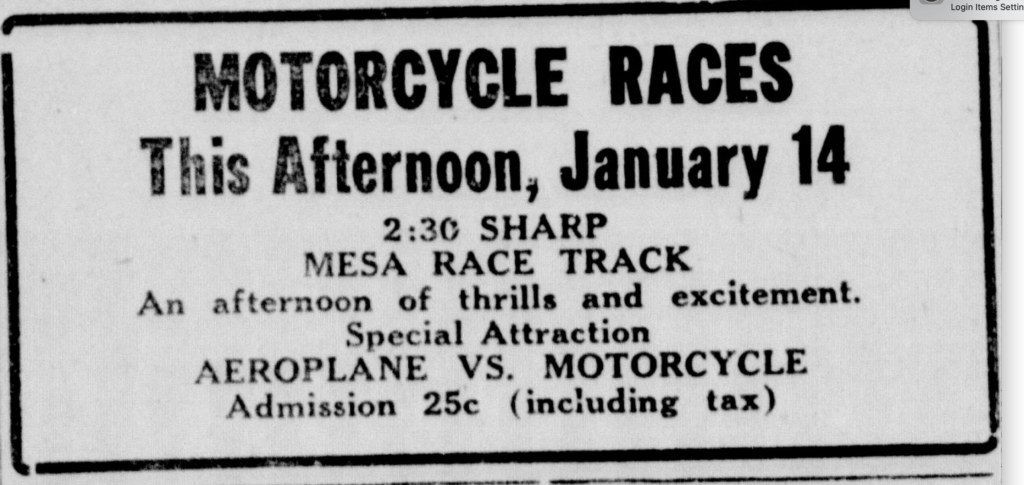
It is unclear exactly why or when the Mesa track closed. However, most likely it was due to the city annexation of land to San Pedro Boulevard in 1925 and the post war housing development boom. The track continues to be visible in 1930’s photographs.
Shifting Gears
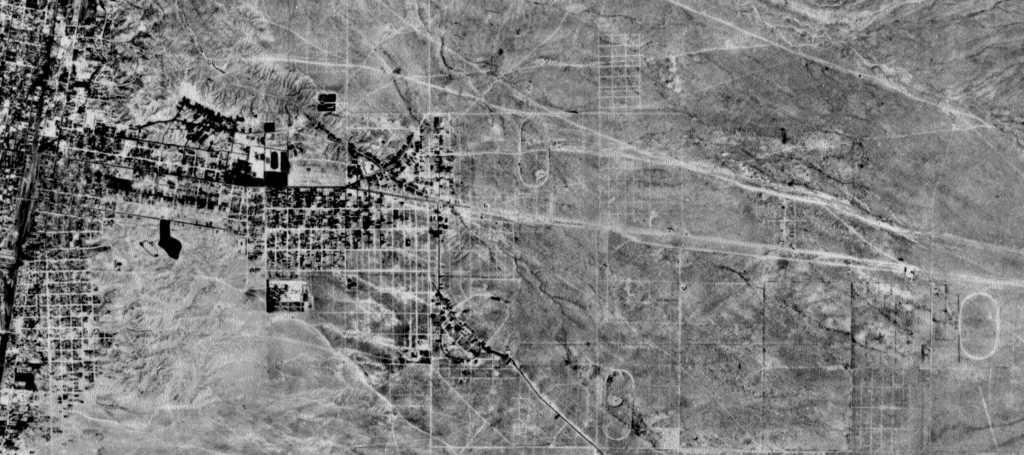
New racing ventures would continue to open on the East Mesa, however. The Albuquerque Racing Association formed in 1925 with former federal prohibition agent Roscoe Bangs serving as manager. The association completed a new track by December with its first race scheduled for January 1st, 1926. The track located at the northeast corner of San Mateo and Gibson Boulevards had the capacity to seat 3,000 spectators and viewing areas along the track for 750 cars.
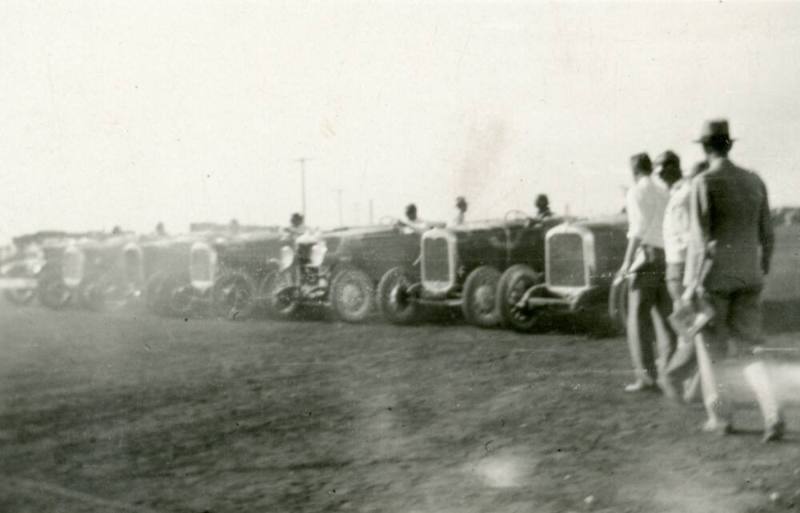
The first race went off with great success. Mayor Clyde Tingley served as honorary referee, and drivers came from Colorado and Arizona. This appears to be the first and last formal race at this location as on January 4th, 1926, the association announced the construction of a more “substantial” 1-mile track to be located southeast corner of Central Avenue and Eubank Boulevard. This track, known as the All-American Speedway, hosted Albuquerque’s first A.A.A. sanctioned race in 1926.
©️ 2026 Michelle Allison